How Community-Based Rehab Enhances Neuro-Musculoskeletal Recovery

Published August 22rd, 2026
The prevailing structure of neuro-musculoskeletal rehabilitation is constrained by insurance-driven timelines and episodic care models that abruptly end just as patients are poised for further neurological and functional gains. This discontinuity leaves individuals vulnerable to regression, as ongoing neuroplastic potential requires sustained, intensive, and progressively challenging activity well beyond traditional therapy durations. The challenge lies in bridging this critical gap between short-term clinical intervention and long-term recovery maintenance.
Long-term neuro-musculoskeletal recovery demands a paradigm shift from finite treatment episodes to continuous, community-integrated care frameworks that maintain and extend functional improvements. Such models must integrate clinical expertise, task-specific restorative therapies, adaptive exercise regimens, and accessible technology to support ongoing neuromuscular engagement and prevent decline.
The following discussion explores how an integrated, community-based recovery approach addresses the limitations of conventional rehabilitation by fostering sustained progress and independence. By rethinking post-discharge care as a continuum rather than a conclusion, this framework offers a replicable, scalable pathway that aligns clinical goals with real-world function, laying the foundation for durable outcomes in neurological and musculoskeletal health.
The Limitations of Traditional Rehabilitation and the Need for Long-Term Support
Standard rehabilitation was built around short, insurance-defined episodes of care, not the biology of long-term neuro-musculoskeletal recovery. Length of stay, visit counts, and authorization cycles shape the plan of care as much as clinical reasoning. The result is a front-loaded burst of intervention, followed by an abrupt discharge at an arbitrary point in the recovery curve.
For neurological and complex musculoskeletal conditions, that discharge rarely coincides with the plateau of neuroplastic potential. Current research on stroke, spinal cord injury, and degenerative conditions shows that the nervous system retains capacity for change for months and years, provided that task-specific, high-repetition, and progressively challenging work continues. When therapy stops, intensity and frequency drop sharply, and so does the stimulus that drives neuromuscular system restoration.
The consequence is predictable. People leave inpatient, outpatient, or home health services with partial gains, limited carryover into community function, and no structured pathway for the next phase of work. Without planned transition into ongoing programs, we see:
Loss of mobility as gait, transfer, and balance skills decay without practice and progression.
Decline in strength and endurance when therapeutic exercise is not replaced with accessible, adaptive fitness.
Increased compensatory movement patterns, pain, and fatigue, which further reduce activity levels.
Reduced independence in self-care, work, and community roles, with higher caregiver burden.
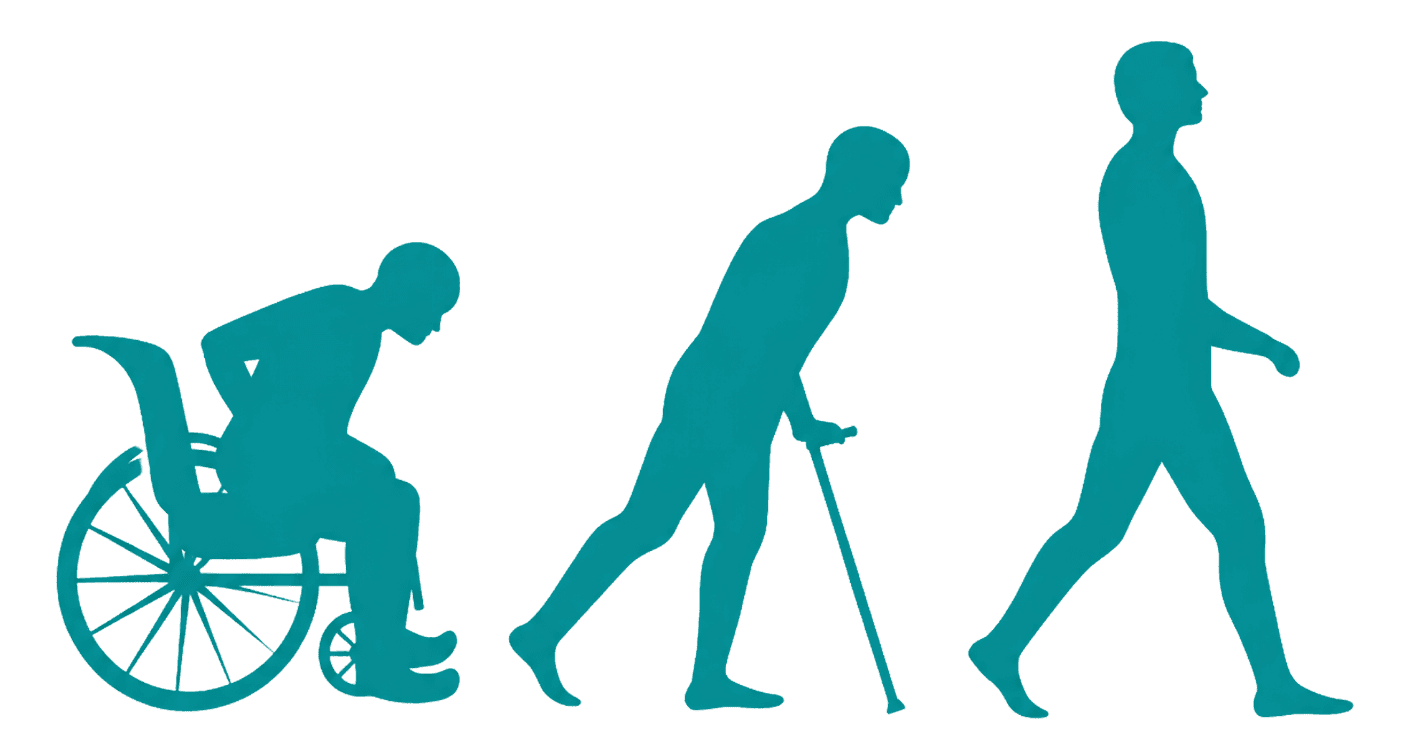
Several longitudinal studies in neurorehabilitation describe this pattern as the "post-therapy cliff": functional gains during formal care, followed by a gradual, then accelerating, regression once the structured environment disappears. The issue is not that therapists fail to teach home programs; it is that most individuals with chronic neuro-musculoskeletal conditions require supervised progression, equipment access, and accountability well beyond what episodic care provides.
Neuroplasticity is experience-dependent. Chronic conditions do not resolve on a 6- to 12-week schedule, and neither does the risk of secondary decline. A model that stops at discharge ignores the ongoing need for targeted loading of the neuromuscular system, real-world practice, and periodic clinical recalibration. This structural gap sets the stage for community-based and extended recovery programs that treat discharge as a handoff, not the finish line.
Activity-Based Restorative Therapy (ABRT): A Paradigm Shift in Sustaining Recovery
Activity-Based Restorative Therapy sits squarely in the gap created when intensity drops off after discharge. Instead of accepting compensations as the end point, ABRT treats them as a temporary scaffold while we work to re-engage pre-injury motor behaviors through high-intensity, task-specific activity.
The core principle is straightforward: load the neuromuscular system in a way that approximates normal movement, at a volume and frequency that drive plastic change. ABRT relies on repetitive, patterned, task-focused work performed with as much weight bearing, upright positioning, and active participation as possible. External supports, technology, and manual facilitation are used to approximate normal kinematics, not to replace them.
Unlike conventional physical therapy models that often pivot early toward compensation and energy conservation, ABRT prioritizes restoration of motor control. The clinical question shifts from, "How can this person manage with what they have?" to, "How much of the original movement pattern can we reawaken with the right intensity and input?" That shift changes exercise selection, dosing, and the progression curve.
The evidence base, particularly from spinal cord injury and stroke rehabilitation, points in the same direction: higher repetition, task-specific gait training, intensive upper extremity practice, and active trunk work improve motor scores, walking capacity, and functional arm use beyond what low-dose, generalized exercise achieves. Studies of locomotor training and constraint-induced movement paradigms reflect the same mechanistic thread that underpins ABRT-activity-driven sensory input reorganizes central motor programs.
Critically, ABRT is not tied to an inpatient gym or a short outpatient plan of care. Its framework extends naturally into community-based programs, mobile neuro-musculoskeletal care services, and adaptive fitness for neuro-musculoskeletal patients. The same principles that drive early gains-task specificity, high frequency, progressive challenge-are scalable into long-term schedules, group formats, and technology-supported home practice.
When embedded in a community model, ABRT becomes the engine that keeps the neuromuscular system under constructive stress long after payor-defined episodes end. It offers clinicians a structured way to pursue neurological recovery instead of defaulting to maintenance, and gives operators a repeatable clinical spine around which long-term programs, data tracking, and technology investments can be organized.
Combining Clinical Rehab, Adaptive Fitness, and Mobile Services to Bridge Post-Rehab Gaps
The post-therapy cliff exists because traditional models stop at impairment-focused care delivered in fixed locations. To extend recovery, the same nervous system that responded to early inpatient and outpatient work needs a structured, escalating set of inputs that move with the person, not just with the payer's authorization cycle.
We treat clinical rehabilitation as the anchor, not the entirety, of that continuum. Licensed therapists define the impairment profile, movement priorities, and safety thresholds. They use neuro-musculoskeletal assessment to set targets for gait, upper limb function, trunk control, and pain management, then translate those targets into clear training parameters: what patterns to load, at what intensity, and with which constraints.
Adaptive fitness then carries those parameters into higher-volume, community-based work. Instead of three visits per week in a clinic, individuals access scheduled sessions that emphasize:
Strength: progressive resistance applied to impaired and compensating muscle groups, with close attention to alignment and motor pattern quality.
Endurance: interval and steady-state conditioning using accessible equipment and bodyweight tasks that match cardiovascular status and autonomic tolerance.
Mobility: loaded flexibility, dynamic balance tasks, and floor-to-stand transitions that mirror real environmental demands.
Within this framework, fitness specialists and therapists share a common language. An ABRT-driven gait priority in the clinic becomes repetitive, supervised walking practice on varied surfaces in the gym. A scapular stability target becomes structured upper body intervals using adaptive equipment. The outcome is not exercise for its own sake, but sustained neuromuscular loading tied directly to clinical goals.
Mobile neuro-musculoskeletal care closes the access gap that blocks many from long-term participation. Transportation barriers, fatigue, work schedules, and caregiver limitations often exclude people from stroke rehabilitation community programs or center-based traumatic injury neuro-musculoskeletal rehab. Bringing skilled intervention and adaptive fitness infrastructure into homes, workplaces, or community settings reverses that exclusion.
Mobile teams extend the same operating model: brief, targeted re-assessment; progression of ABRT-based tasks in real environments; and installation or optimization of home-based long-term rehabilitation programs using portable equipment and technology. Data from these visits feed back into clinic and gym programming, so progression remains coordinated, not fragmented across settings.
The practical market implication is clear. Health systems and payors already recognize the cost of regression after discharge, but most offerings still separate therapy, fitness, and home services into different silos. A community-based recovery system that deliberately integrates clinical rehab, adaptive fitness, and mobile delivery creates a single, scalable pathway that reduces drop-off, maintains neuromuscular gains, and extends recovery curves instead of accepting decline as inevitable.
Sustaining Functional Gains Through Community-Based Recovery Programs
Once ABRT, adaptive fitness, and mobile care are aligned, the next question is operational: how do we structure community programs so gains are not only protected, but extended? The answer lies in predictable dosing, defined roles, and deliberate pathways for community reintegration.
Effective community-based neuro-musculoskeletal recovery programs share several design features:
Consistent, scheduled intensity: Standing calendars for gait, upper limb, trunk, and conditioning work, rather than ad hoc visits, keep the neuromuscular system under regular load.
Integrated occupational therapy: Occupational therapists translate clinical gains into task performance in self-care, household management, and work roles, then set measurable participation targets.
Layered social structure: Small-group formats, peer pairing, and supervised open gym times create accountability, reduce isolation, and normalize long-term training after stroke, spinal cord injury, or traumatic orthopedic events.
Feedback and data loops: Periodic re-testing anchors progression to objective changes in strength, walking distance, hand use, balance, and activity participation.
The research base in neurorehabilitation consistently supports this pattern. Trials of community-based stroke programs show that structured, higher-frequency task practice combined with occupational therapy-driven activity planning improves walking capacity and self-care performance more than usual care. Community locomotor training for spinal cord injury has demonstrated maintained, and sometimes improved, walking endurance when intensive stepping practice continues in group and home-based contexts. For chronic musculoskeletal trauma, supervised, function-focused community exercise reduces pain interference and preserves return-to-work rates compared with unsupervised home exercise alone.
Occupational therapy and community reintegration strategies sit at the convergence of these findings. Therapists map body-level changes into role performance: transfers into car travel, grip strength into cooking and tool use, dual-task balance into safe navigation of crowded environments. Community outings, graded return-to-work trials, and practice in real environments shift the target from impairment management to participation, which aligns with long-term quality of life data across neuro and complex musculoskeletal populations.
When community-based neuro-musculoskeletal recovery is built this way, clinical rehabilitation, ABRT, adaptive fitness for neuro-musculoskeletal patients, and mobile services become one operating continuum. The measurable impact is not just preserved range or gait speed; it is sustained participation, reduced caregiver load, and slower functional decline curves years beyond the original injury.
Measuring Outcomes and Ensuring Scalability in Community Neuro-Musculoskeletal Recovery
For community-based neuro-musculoskeletal recovery to influence practice patterns and capital allocation, it has to move beyond good intent and individual clinician judgment. Standardized protocols, clear outcome definitions, and disciplined data capture turn an integrated model of clinical rehabilitation, Activity-Based Restorative Therapy, adaptive fitness, and mobile services into an operating system that can be evaluated, refined, and replicated.
The anchor is a shared clinical and functional metrics set. Strength grades, gait speed, walking distance, upper limb dexterity, trunk control, and pain interference scores sit beside measures of independence in self-care, work, and community roles. Layered onto that, quality of life indices and caregiver burden scales describe whether gains translate into participation and stability in daily life.
Tracking these data on a defined cadence across all program elements creates three advantages:
Validation: Demonstrates that ABRT-driven intensity, adaptive fitness, and mobile visits sustain or extend gains after traditional rehab ends, rather than letting them erode.
Refinement: Exposes which protocols, frequencies, or technologies correlate with meaningful change, so underperforming elements can be redesigned instead of repeated by habit.
Comparability: Allows performance to be reviewed across cohorts, payor types, and locations, which is central to any long-term investment thesis.
Scalability depends on turning this into a teachable, technology-enabled platform. Standard training pathways for therapists, exercise professionals, and mobile teams create consistency in how ABRT principles, functional electrical stimulation therapy, and adaptive tasks are delivered. Integrated software for documentation, outcome tracking, and scheduling links clinic, gym, and field work into one dataset rather than three disconnected charts.
With that foundation, multi-site replication stops being an act of faith and becomes a controlled expansion problem. New locations adopt the same clinical spine, data definitions, and operating rhythms, while local teams iterate within defined guardrails. For investors and strategic partners, this combination-measurable outcomes, repeatable workflows, and demonstrable portability-is what turns community-based neuro-musculoskeletal recovery from a promising concept into a scalable asset class.
The persistent gap between traditional rehabilitation and sustained recovery demands a transformative approach-one that integrates clinical rehabilitation, Activity-Based Restorative Therapy, adaptive fitness, and mobile care within community settings. Addressing this gap is critical to altering the trajectory of long-term outcomes for individuals with neurological and musculoskeletal conditions, moving beyond episodic care toward continuous neuromuscular engagement and functional participation. The ReAbility Group's model exemplifies a replicable, scalable framework that aligns clinical evidence with operational rigor, creating a unified system that supports ongoing recovery rather than accepting decline as inevitable. This integrated approach not only preserves and extends functional gains but also reduces caregiver burden and enhances quality of life. For healthcare partners and investors, the opportunity lies in advancing a community-based recovery paradigm that responds directly to unmet market needs while generating measurable, sustainable impact. We invite stakeholders to explore how this model can redefine neuro-musculoskeletal rehabilitation and unlock long-term value across care continuums.